In March 1977, English glass gaffer Fred Daden came to Inglewood,
Taranaki, at the invitation of Tony Kuepfer, where he spent a month
showing Tony the finer points of studio glass technique.
 |
| Fred Daden blowing at Inglewood, March 1977: a screen capture from the film |
During its archiving project, two reels of colour 16mm film were located by NZ Society of Artists in Glass amongst the files of Mel Simpson, a founder of NZSAG and formerly Lecturer in Glass at Elam School of Fine Arts at Auckland University. At that stage, Mel was not sure what the film showed. The two reels were joined into one and transferred to DVD, to make it more accessible, but since there is no sound, no titles and no credits it wasn't until it was shown at the NZSAG Conference in Auckland in October 2016 that it was recognised for just what it was. Auckland glass artist Peter Raos was at Inglewood in 1977 and also at the 2016 Conference, and he at once recognised it. Stuart Park, glass blogger, also knew that Fred had been at Inglewood, and recognised Tony's studio. Excited discussion ensued, and the story of the film and its making emerged. This blog has been compiled by Stuart Park, with considerable assistance from Tony Kuepfer, Mel Simpson and Peter Raos. Mel paid for the film stock, and an Elam film enthusiast, Wilton Roger, shot the footage for him. Acknowledgements too to NZSAG, especially then President and Secretary Heather Oleson and Lisa Mak.
Tony Kuepfer was born in Oregon in 1947. After doing a business degree at the University of Portland, he discovered the small glass course running at Portland State University, and spent two and a half years working in the glass studio. In Oregon, he met Carolyne, a Kiwi, and decided to come and spend a year in New Zealand, arriving in December 1973. But 4 months earlier, in London, he had met Fred Daden, who was Technical Tutor in Glass at the Royal College of Art in London. Fred had been a top gaffer in the English glass industry, at Whitefriars, when RCA pulled him in to teach in their glass programme.
 |
| The disused church at Inglewood Tony that converted into his studio (now a church again - the Inglewood Apostolic Church). Photo: Stuart Park 2004 |
 |
| The hard-won gas pipe and meter. Photo: Stuart Park 2004 |
In New Zealand, Tony decided to make glass. He went to Taranaki in March 1974 – some friends had mentioned the old church at Inglewood. He went to see the Council, to arrange access to gas, because the church was outside the gas franchise area. They said this would be OK, but the Gas Corporation said no, saying he was too small a user – this was the era of Think Big, which had tapped into vast reserves of natural gas. That led to nearly a year of negotiation. Tony took out a business development loan, conditional on the gas being agreed, and used that as leverage to get approval for the gas. Gas came on early in 1975 – prior to that he was making stained glass lampshades. Tony made his first hot glass in NZ in 1975.
In 1976, Tony was invited to attend the first international conference on hot glass at the Royal College of Art in London, so he renewed his contact with Fred Daden. At the conference Tony became aware of the distinction between the American approach to hot glass, where technique was not highly regarded, and the English approach in which technique was seen as the most significant, and of which Daden was a master. He realised that he would benefit enormously from working with Fred. So in March 1977, at Tony’s invitation, Fred Daden, accompanied by his wife Barbara, came to spend a month at Inglewood. Tony described this month as being equivalent to the amount of glass making he would have had in a yearlong diploma course. Tony says he learned a great deal from Daden, technically, especially how to make glass move – “a good piece is a fast piece”.
 |
| Fred brought his own Ivan Smith English glassmaker's tools with him. They were revelations to the New Zealanders, who ordered some immediately. Photo: screen capture |
In the film we see Fred Daden making glass at Inglewood, goblet after goblet, as well as some other objects. The camera lingers on his flowing hand movements, keeping the pipe and the glass moving continuously, in the way all master glass-makers move. Fred is the rather elegant gaffer, hair brushed, in well ironed shirt and tailored trousers. Tony is his ‘punty boy’, long haired, mustachioed and wearing rather short shorts. The contrast between the American and the Englishman is plain to see, but importantly, they had become, and continued to be, close friends. The Englishman is passing on the skills and techniques of the English glass tradition to this, at that time relatively unskilled, American.
 |
| Tony Kuepfer and Fred Daden in Tony's studio at Inglewood. Photo: screen capture |
The film is unedited, with some of the sequences being a bit repetitive. We don't see Fred making any single piece completely from start to finish. Peter Raos has used his glass-maker's eye to provide some helpful comments, after viewing the film again recently:
"Fred is captured making several items and if you are not a glass blower it might seem a bit random. At one point he is making a clear wine glass with a drawn stem which includes a 'tear drop' bubble in the stem. We don't see the step where he sets that up but you can make out the bubble in the stem when the piece is near to being put away. Other drawn stem pieces show up at the end on the product shelf as air twist wine glasses. Fred knew how to make these but he had to practise; they got really fine and elegant towards the end. He is also shown making the cast on stem wine glass with a single bit as well as the more bucket shape bowl with multiple bits making up the stem. These multi bit stems are really tricky and Tony's glass was quite a soft formula, so you see Fred chilling those bits with the tools to keep it all straight. The use of the calipers to measure the bowl and the stem to create a standard height for sets of glasses also shows his training for making multiples of the same design in a run of production.
"The trailed glass platter is employing one of the oldest known decorative effect in glass, the hooked trail, which goes back several thousand years. Fred would have been shown many things in his career as well as working out new approaches to making things and all this knowledge is passed on by doing and watching others do. He came to NZ at a time when we knew pretty much nothing.
"Fred came from the apprentice system where all the kinks were ironed out over the years and you eventually earned your place as the gaffer and the servitors did what you told them. He said that the office would send down drawings and they would figure out how to make the piece on the shop floor. Then they would set about producing that piece until they were told to stop.
"The bench or glassblower´s chair was made to Fred´s specifications [with its unusually long arms]. I had forgotten how he parked his jacks on the arm like that. We copied that move for a while but I kept burning my forearm on the hot blades, it was just a personal style thing that he did I guess."
Thanks for those comments, Peter.
 |
| Fred in neatly laundered shirt, Tony in his habitual shorts (glass studios are hot places). Photo: screen capture |
There are a few other people in the background of the film. We see a second cameraman briefly at one stage, and there are the legs of people with different coloured trousers than Tony’s shorts. Peter Raos identified the punty boy who assists at 22 minutes 25 seconds onwards as being Howard Tuffery, now a noted Taranaki sculptor in stone and wood, who was assisting Tony in the studio at this period.
 |
| Howard Tuffery assists as Fred's punty boy. Photo: screen capture |
Peter Raos was one of a group of 3 students from Elam, who set off in Mel Simpson's car on a field trip to see Fred blow glass. Peter has 2 wine glasses he purchased at the time, signed F. Daden 1977.
 |
| Peter Raos bought these glasses from Fred at Inglewood; they are signed Daden NZ 1977. The film shows Fred making goblets just like these. Photo: Peter Raos |
As an exercise Peter and Mel sketched pieces and asked Fred to make them. Perhaps as a challenge, Mel drew a complicated double handled piece with a separate lid. Fred said he didn’t like it, particularly the foot detail. However he simply got stuck in, making Mel his punty boy. Mel describes nervously bringing globs of glass to Fred and says the piece turned out absolutely exactly as he had drawn it. ‘Amazing - he was very clever craftsman indeed’, Mel said. Peter Raos, too, sketched a piece that Fred made, which he still has. Peter notes that they must have stayed overnight because the pieces he made from the drawing had to be annealed. In the film we see Tony putting pieces into the annealing oven several times.
There's an interesting small technical detail from 10 minutes 27 seconds onward. Fred uses the handle of his tongs to make the first of two cross marks in the nubbin of glass on the pontil that will be used to pick up the finished object, a technique that leaves a distinctive 'Maltese Cross' punty scar. The purpose is to provide a weak point where the object being made will snap readily off the pontil, reducing the risk of breakage. This scar is often used by collectors to distinguish Tony Kuepfer's post Fred Daden glass, though Tony (and Fred) were by no means the only glass artists to use this method.
 |
| Fred presses the handle of his tongs into the nubbin of glass on the end of the pontil that will be used to pick up the finished piece. Photo: screen capture |
 |
| Signed AWK 86 Stuart Park collection |
 |
| These two 1980s pieces by Tony Kuepfer show the distinctive Maltese cross scar. Stuart Park collection |
At the end of the film the camera spends some time looking at glass objects being offered for sale in Tony’s studio, some made by Fred Daden. These include many objects recognisable today as typical of Tony’s early production, including a platter such as we see being made in the film, and wine glasses, including some air twist stem glasses. There are also mugs, which Tony says Fred showed him how to make proper handles for and achieve an even thickness. I have included images here of pieces from my own collection which closely resemble pieces seen in the film.
 |
| Tony says Fred brought the letters on this commemorative beaker with him from England. Carolyne was Tony's wife and Barbara was Fred's wife. Sadly the piece no longer survives. Photo: screen capture |


Several mugs like these may be seen displayed for sale. These ones are unsigned and undated, from Stuart Park's collection Photos: Stuart Park
 |
| SP collection jug signed AWK 77, Tony's initials |
 |
| SP collection paperweight signed AWK 77 |
 |
| SP collection, signed AWK 86 |
 |
| SP collection, unsigned and undated |
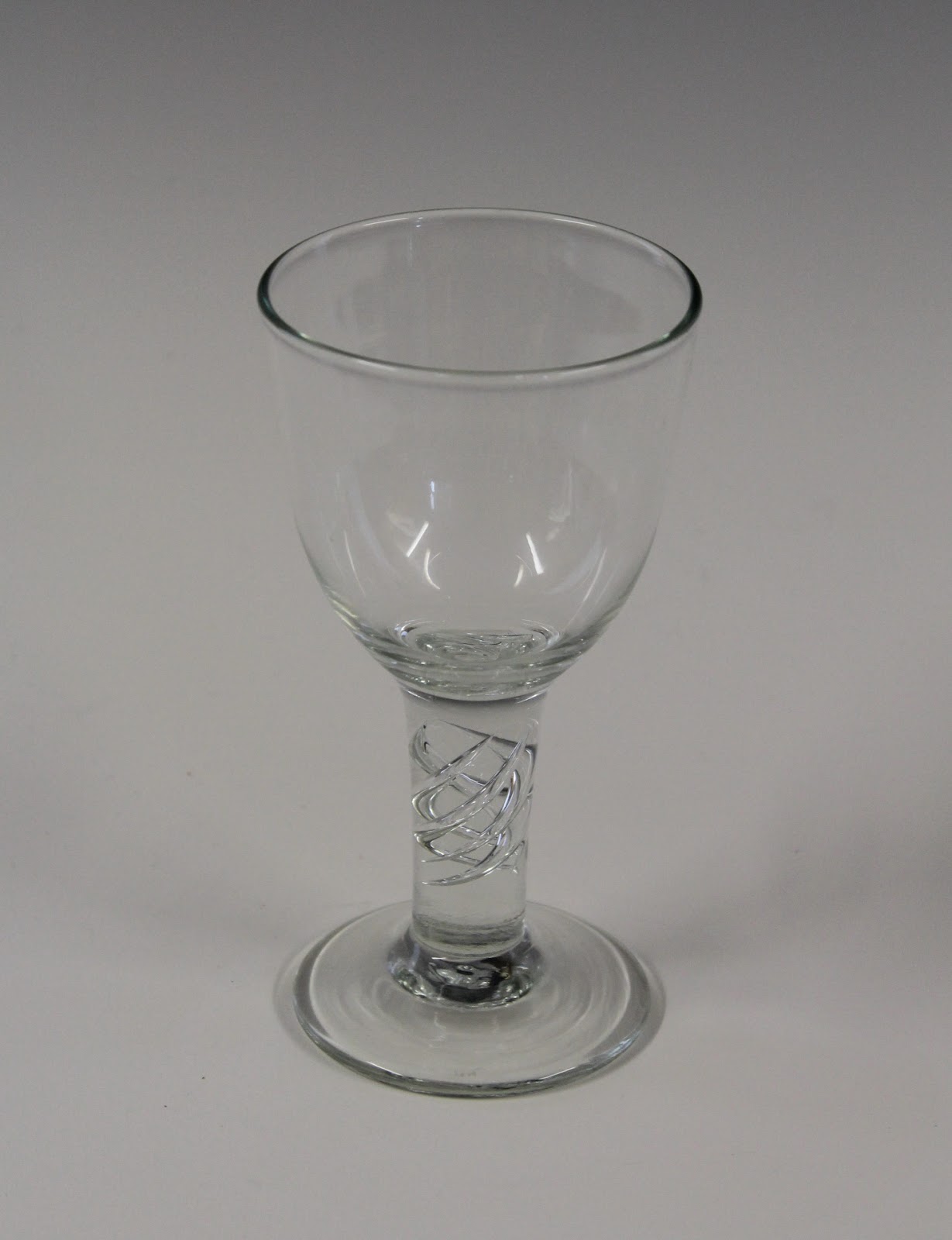
This air twist stem goblet is signed and dated AWK 92.
See the air twist stems in the 1977 screen capture as well as Peter Raos' comments above.
The lessons Tony learned in 1977 have stood him in good stead over the years.
Stuart Park collection.
Because there is no sound with the film, we don't get a very good idea of Fred as a person. Peter Raos has said: 'Fred had a very even sort of temperament but he was very strong willed and focused when in the chair and handling the glass.'
 |
| Photo: William Walker |
English studio glass artist William Walker was a student at the Royal College of Art from 1977 - 1979, and in an email exchange he kindly provided information about Fred, as well as this photo of a swan he made under Fred's tuition at RCA. Some very similar swans appear amongst the objects at the end of the film.
William describes Fred as 'one of the finest craftsmen ever to walk the earth. He had no artistic ability but, boy could he make glass'. He would say, ''there's only one way to do this, Bill, an' that's the right way".
"Fred was a classically trained glass-maker and taught me to make glass in the traditional way. He taught me to gather properly, and if you can't gather, you're wasting your time. Go back to the beginning and understand what's going on on the end of the iron and WHY. I'll always be in his debt as he taught me properly."
"I got dead lucky as I spent a lot of time with him, sitting behind his bench watching his every move and he relating to me what was going through his mind. He would say things like 'Be brave, do all the work in the 'ole..(glory hole) an' if you cut in 'ere, you'll get a noice fine rim...he had a thick north London accent, so think of how you would mimic a cockney and you're nearly there!
I emailed William back to explore how Fred might have sounded if the film had had a soundtrack. I asked if a 'thick North London accent' might sound a bit like English actor Dennis Waterman, seen here on TV in Minder and New Tricks. William's response was "brilliant, Dennis Waterman's is typical of the classic London accent!" So now we can imagine Fred's voice as we watch the film.
Fred stayed a month in Inglewood in 1977. But when Tony Kuepfer was involved in preparations for the NZSAG Conference to be held in Inglewood in April 1983, he made sure that Fred was one of the invited international guest lecturers / demonstrators . They were a distinguished bunch: as well as Fred there was Makoto Ito (Japan), Marvin Lipofsky (USA), Johannes Schreiter (Germany), and Australians Peter Minson and Keith Rowe. I blogged about the conference in 2012; Fred appears at the right in both the group photos I published there ( http://newzealandglass.blogspot.co.nz/2012/08/nz-society-artists-in-glass-conference.html ).
In these photos taken at the Conference by Tim Edwards, Fred, behind, is watching Peter Minson, while in the detail from the group photo the parking sign arrow points him out.
 |
| Photo: Tim Edwards |
 |
| Photo: Tim Edwards |
As he had done in 1977, Fred made pieces for sale in 1983 to help defray the costs of his participation in the Conference. This platter, not unlike some we see being made in the 1977 film, found its way into my collection by way of TradeMe in 2008.


Following the 1983 Conference, Fred spent some time at the Hot Glass Company in Devonport with Peter Raos and Peter Viesnik, and they too very much appreciated the opportunity to learn from such a skilled craftsman.
After 1983, Fred did not return to New Zealand, but he and Tony kept in touch. Fred did come back to this part of the world, since in January 1987, AusGlass held its 5th National Conference in Melbourne, with 'overseas guest Fred Daden (hot glass)'. Tony and his mother (who had developed a warm friendship with Barbara Daden), went to see Fred in Melbourne during AusGlass.The families exchanged Christmas cards for a number of years, before losing contact in more recent times.
Sadly, Fred Daden died at home in London in November 2013.
I am very grateful to those who have provided information to assist in the production of this blog. However, responsibility for the content and any errors rests with me.
The following run-time list may be helpful if you are watching the DVD in detail:
Track 1 NZSAG Archive Footage header (30 seconds)
Track 2 Fred Daden and Tony Kuepfer at Inglewood, March 1977 43:49
Elapsed time
|
Shot list
|
0:00
|
No titles
Tools laid out on bench
|
0:15
|
Looking over right shoulder of Fred Daden in
glassmaker’s chair, making a wine glass. Forms the bowl, adds glass for the stem.
Shorts-clad legs of Tony Kuepfer appear occasionally
|
2:06
|
Tony brings Fred a gather of glass on a punty for
the foot
|
2:38
|
Fred wets and cools the tool with his mouth,
releases the goblet from the pipe. Tony returns it on a punty, Fred trims the rim with
shears
|
2:50
|
Fred widens the mouth of the goblet
|
3:07
|
Fred checks dimensions, stands and turns to tap
punty to release goblet.
|
3:20
|
Fred rolls new gather on the marver, sits in chair to
shape with paddle
|
4:06
|
Fred blows into the pipe
|
4:30
|
Applies glass for stem from punty to base of
piece
|
4:47
|
Tony assists with shaping of stem
|
4:57
|
Fred continues to shape stem
|
5:18
|
Tony hands Fred a second punty, takes pipe while
Fred adds glass for foot (camera watches Fred’s fingers rolling the pipe –
Fred’s fluid, skilled glass-maker’s hand movements are featured throughout
film).
|
5:42
|
Tony brings punty to take goblet off pipe
|
5:58
|
Fred releases goblet
|
6:05
|
Fred sits down with new gather
|
6:17
|
Fred uses glory hole, then blows into pipe,
manipulates pipe to enlarge bubble
|
6:37
|
Fred sits at chair to continue
|
7:07
|
Flashing goblet in glory hole
|
7:18
|
Trimming rim with shears, enlarging bowl, hands
finished goblet to Tony
|
7:53
|
New gather
|
8:15
|
Working at glory hole
|
8:45
|
Seated in chair, again Tony brings punty with
glass for stem, assists Fred in forming stem
|
10:15
|
Foot has been added
|
10:27
|
Fred uses handle of tongs to make cross mark in
glass on punty, a technique that leaves a distinctive ‘Maltese Cross’
punty scar, often used by collectors to distinguish Tony Kuepfer’s post Daden
glass.
|
10:33
|
Tony applies punty to foot
|
10:45
|
Flashing goblet in glory hole, finishes shaping,
hands finished goblet to Tony
|
11:17
|
New gather on marver
|
11:26
|
Brief glimpse of a second movie cameraman, in
black shirt and fawn trousers
|
11:27
|
Seated in the chair, shaping
|
11:36
|
A breath, then the process continues as
previously
|
12:20
|
Fred forms then applies the glass for the foot
|
12:43
|
Tony (out of shot) takes goblet onto punty, Fred
uses his mouth on tool, releases goblet from pipe
|
13:03
|
Fred uses shears to trim rim
|
13:22
|
Tony cools punty junction, releases finished
goblet from punty in annealing oven (top opening, chest type). Chipping the
glass to release the punty appears difficult, more than once
|
13:45
|
Applying punty to base of next goblet
|
14:25
|
Glory hole
|
15:16
|
Again, tapping punty to assist release of goblet
|
15:28
|
Glory hole
|
15:42
|
Making an ovoid platter with lighter coloured
‘feather’ decoration – a typical ‘Kuepfer’ piece
|
16:55
|
New gather for another goblet
|
18:05
|
Glory hole
|
18:30
|
Tony gathers glass on punty from furnace for foot
|
18:53
|
Fred applies punty for foot
|
19:10
|
Fred uses wooden form to shape foot
|
19:35
|
Glory hole flashing
|
20:23
|
Fred places finished goblet in annealer
|
20:28
|
New bubble, another goblet
|
22:25
|
Howard Tuffery brings a punty with glass for Fred
to form the foot
|
23:08
|
Howard takes the finished goblet onto a punty
|
23:12
|
Another goblet, the same sequence of events
|
25:19
|
Applying a white trail to another gather
|
25:28
|
Fred pulls the trail on the surface of the
gather, reheats, further pulls
|
25:55
|
Rolls the piece on the marver to merge the pulled
trail
|
26:25
|
Fred uses wooden form to shape the sphere
|
26:40
|
Blowing to enlarge the sphere
|
27:10
|
Flattening the base
|
27:30
|
Transfer to punty, reheat in glory hole
|
28:05
|
Marvering the vase
|
28:50
|
New gather
|
29:20
|
Shaping with paddle
|
29:27
|
Fred applies white trail from punty to vessel on
pipe
|
29:54
|
Uses tool to pull decoration, reheat, repeat
|
30:57
|
Wooden spherical tool to shape vessel
|
31:17
|
Blows
|
31:46
|
Cuts to finishing work on goblet, removes from
punty onto glove on floor
|
32:00
|
New gather for a goblet
|
32:14
|
Tony uses wooden paddle to help shape stem
|
33:00
|
New gather for foot, which punty boy in purple
jeans (Simpson, Raos?) applies
|
33:54
|
Finishing goblet, an elegant conical, clear wine
glass
|
34:20
|
Fred in chair working feathered vessel
|
35:00
|
Flattens base of piece
|
35:32
|
Punty boy in flared blue jeans takes piece onto punty,
flashes in glory hole and spins to form platter
|
35:57
|
Fred in chair works to release platter
|
36:03
|
Cut to display of finished glass pieces on
shelves – mugs hanging by handles, wine glasses, vases, typical Kuepfer
pieces from this period. Some of the wine glasses have air twist stems. A
white cylinder has applied purple and blue text in block letters
CAROLYNE TONY
NEW ZEALAND HOT GLASS
BARBARA FRED 77
|
Through to 40:10
|
Film pans around the works on the shelves. There
are a couple of swans, typical of factory ‘homers’, such as made in Christchurch
and at Hokitika, but very typically Whitefriars. Pieces have adhesive price
stickers. A platter, a stoppered decanter.
|
40:14
|
A newspaper cutting featuring Fred is pinned to
the wall ‘English Glassblower shares skills’, and another cutting showing 3
people in the studio
|
40:22
|
Zooms into closeup on a platter, picking up
bubbles and light effects
|
41:14
|
Close up of foot of clear wine glass, with bubble
in stem
|
41:36
|
3 clear ‘bucket’ wine glasses, one with small
colour spots
|
41:50
|
3 ‘Bristol blue’ wine glasses
|
42:20
|
4 clear wine glasses with green stems
|
42:45
|
Paper weight with 2 bubbles in centre of flowers
|
42:58
|
Amorphous paperweight
|
43:13
|
Clear ‘bucket’ wine glass with small colour spots
|
43:49
|
Ends – no titles
|


