Sunday, 19 May 2013

Whanganui Plans a Great Festival in September 2013

I've had a couple of pleasing responses to my blogs recently. Chuck and Indiah Simpson's daughter, Whitney-Leigh emailed, expressing appreciation of my words and photos of her parents' work from Inglewood in the 1980s. And the latest Newsletter of the Wanganui Glass Group says "Stuart’s Blog is very well researched and is a great starting point for all of us with an interest in, and appreciation for NZ Glass." It's great when those I write about are interested to read what I write!

The Newsletter also brings preliminary news of the events that are being planned for the Wanganui Festival of Glass, to be held in Whanganui from 7 - 15 September this year. Whanganui is a city that its proud of its glass artists, and the annual Festival showcases the best of their work.  The Festival provides a wide range of opportunities to see glass exhibitions, visit artists in their studios, watch visiting glass experts as they give master classes, admire the work of the up and coming among the students at the Whanganui Glass School, and, of course, to acquire glass. It looks like a very full programme, with many of the best features from past year's events as well as some new ones. I'm certainly hoping to be able to get to Whanganui during that week to take part.


The flyer for the Festival pictured at left features the distinctive work of Whanganui glass artist Carmen Simmonds. Herself a graduate of UCOL Whanganui, and a Ranamok finalist, Carmen has a studio in the countryside outside Whanganui.


The Glass Group Newsletter advises that one of David Traub's beautiful platters (at right) will feature on the poster, the billboards and the event guide for the Festival. David is a former Head of the Glass School, whose involvement in making glass goes back to 1973.


I am delighted to have in my own collection an early example of David's platters, which he made in 2002.


Monday, 11 March 2013

One Good Tamarillo...

I wrote yesterday about the wonderful tamarillos of Lou Pendergrast-Mathieson. But you can't talk about glass tamarillos and not refer to the work of Fran Anderton, who has made tamarillos very much her own fruit.  I have admired them for quite a while, and was very pleased to be able to acquire one from the Whanganui Glass Festival exhibition in October last year.


Fran was born in England (and nothing wrong with that, I say assertively) and moved to New Zealand as a schoolgirl.  She trained in glass design and production at UCOL Whanganui, graduating with a Diploma in 2003. She has a strong interest in the natural environment, which she attributes in part to having a plant propagator for a mother and a florist for a sister, though Fran says she is also influenced by the uniqueness of New Zealand's beautiful native bush, beaches and scenery. Avocadoes, citrus and olives have all provided inspiration for her bottles and bowls, but in my view it is her tamarillo bottles that are the most successful.  

Fran makes both cast and blown glass in her purpose built home studio in Whanganui.
Her website is at http://www.frananderton.co.nz/About.aspx


Sunday, 10 March 2013

Tamarillos and Esther James - who was she?

In spite of the severe drought we are experiencing in Northland presently, a tree in my garden has sprouted two very fine tamarillos (aka tree tomatoes). Which is a bit surprising, since it isn't a tamarillo tree.


In fact, these tamarillos are cast glass, with stainless steel foliage and twigs. They are a collaboration between Auckland glass caster Lou Pendergrast-Mathieson and stainless steel fabricator Phillip Moodie.  I saw a 'crop' of these in another non-tamarillo tree in the exhibition Re:Fraction 2012: the Outdoor Glass Exhibition at the Sculpture Park, Waitakaruru last spring. I was struck by their simple beauty, and knew at once I could find a host tree in my own garden.

What I was less clear about (indeed, really puzzled about) was the title that Lou had given these: 'A Tribute to Esther James'. Who was Esther James? 1950s Hollywood star? 1920s Paris dancer? Both seemed vaguely possible, though why tamarillos would be a tribute was quite mysterious.

Researching Lou's glass work on the Internet told me that she and Phillip had exhibited a whole tree of fruit at the Auckland 'Sculpture on the Shore' exhibition in 2010, and had shown similar fruit at other exhibitions. Lou has since told me that they made about 42 fruit all told, tamarillos, pears, apples, plums and peaches, and they have been 'a massive hit'.  


In much of her cast glass, we are told, Lou has a passion for the Art Deco era, and her work is influenced by the glass of the 1920s and 1930s, with soft finishes and engraved surface details. The decoration often makes reference to the gardens of the time.  Lou has a continuing interest in the decorative embellishment of objects combined with a love of the New Zealand landscape.  In her work she uses New Zealand native plant specimens and nostalgic flowers from the garden as decorative elements. 

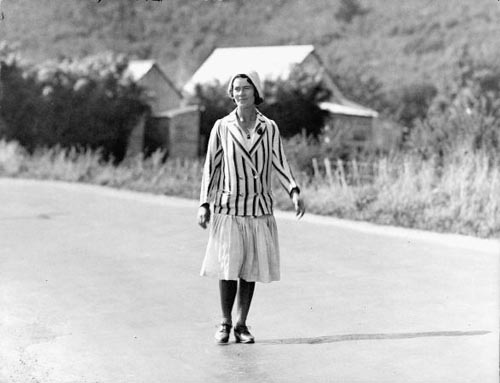
Esther Marion Pretoria James on her walk from Spirits Bay to Stewart Island, 1931-32
(Alexander Turnbull Library photo)

Lou's interest in things New Zealand, in art deco and in the idea of a 'Buy NZ Made' campaign led her to discover a remarkable New Zealander Esther James, who was a campaigner for 'Buy New Zealand Made'  in the 1930s. In 1932, James walked from Spirits' Bay in the Far North to Stewart Island to draw attention to the issue.

Lou says that when she read Esther James's 1965 book Jobbing Along in 2010 it made quite an impact on her and she felt compelled to celebrate the remarkable exploit and the wonderful NZ pioneer woman that Esther James was, but also to comment on the same issue some 80 years later.

Thanks to Lou, I now know who Esther James was - inventor, entrepreneur, model, author, crocodile hunter, opal miner - what a life!  I would encourage you to read about this remarkable New Zealander - her biography is on Te Ara at http://www.teara.govt.nz/en/biographies/4j2/james-esther-marion-pretoria and her book is in your local library.

So now when I wander in my garden, I can admire Lou Pendergrast-Mathieson's glass, and also be reminded of the remarkable Esther James, to whom this work is a tribute. 

Tuesday, 12 February 2013

New Glass for Whakapara Marae

I have mentioned before my admiration of the glass of Northland artist Kathy Shaw-Urlich. Yesterday I had the privilege of visiting Kathy in her workshop and seeing the wonderful new glass windows she is designing and making for the marae of her Ngati Hau people at Whakapara, north of Whangarei

This is a project supported by a Te Waka Toi Creative NZ Arts Grant, which Kathy was awarded last year.  A new wharekai (dining room) Te Tawaka is to be built next year, and the project includes three windows for that, which Kathy has almost completed. Currently she is working on the three panels that will fit in the main window of the wharenui Te Ihi o Nehua, which was opened in 1998 (see http://www.naumaiplace.com/site/whakapara/home/page/147/marae-buildings/).

The designs for the windows have been developed by Kathy arising from discussions on the marae. There were also visits to places that are special to Ngati Hau such as the river and waterfall Waiariki and the maunga Huruiki. Kathy then selected and cut to shape just the right pieces of glass.  Some of them she has formed in the kiln and decorated with appropriate designs, with assistance from some of the people of the marae.

 
The wharekai windows contain themes and elements that relate to the awa (river), with tuna (eels) and fishing being depicted, and watery elements in the design.  The wharenui window relates to the sense of being on the maunga, with its wide views over the landscape. It includes on one side reference to the eponymous ancestor of Ngati Hau, Hautakowera, who is depicted by the reamy glass representing his breath (hau) and on the other side the dogskin cloak with its stylised cloakpin which represents Kahukuri, son of Hautakowera. There is also reference to the obsidian (volcanic glass) which occurs on the mountain.


 These cut pieces will be finished and leaded to form the central portion of the wharenui window

Even in the rough surroundings of the workshop, the beauty of these windows was evident - when they are finally installed in place, they will look amazing.

This project follows on from Kathy's making of the window for the adjacent St Isaac's Church at Whakapara in 1999. The window in the church (below) also contains many references to places, people and ideas important to Ngati Hau.  


When the wharekai is opened, Whakapara will have a remarkable group of buildings with wonderful stained glass by this talented artist who is one of their own. 


Thursday, 17 January 2013

Avalon postscript - a New Zealand glass Film Star

In my last post I talked about the history of Avalon Glass, based largely on the account of it by one of the founders, Greg Smith.  Greg has provided a few corrections and clarifications of the roles of some of those involved, which is much appreciated. But he has also provided an update on what he is doing now.  Not currently making glass, he has been pursuing his career as an actor, and is about to be seen in New Zealand cinemas in the new release Mt Zion (in NZ cinemas from 6 February 2013).


Greg may be seen in the trailer which features on YouTube at http://www.youtube.com/watch?v=N0gHwasfR7g, and the screen captures shown here are drawn from there. Greg plays a promoter who auditions the wannabe Bob Marleys who are the centrepiece of the story - 'some sort of welcoming party for Captain Cook and his Endeavours' is a memorable line.

I know little about the film other than I have seen in the trailer, but you may be sure I'll be going to see it, and not just to see this early NZ glass artist in his new role - it looks like a great movie.

Saturday, 8 December 2012

Avalon Glass Should Not Be Forgotten


One trap when you try to write a short history of something is that you leave somebody out. When I wrote my essay The beginnings of New Zealand glass in New Zealand Glass Art (Bateman 2010), I made just that mistake. I tried to describe all the glass studios that were in existence in the 1970s and 1980s, but sadly I left out a small but important example, Avalon Glass which was set up in 1985 near Fox River on the West Coast of the South Island. Although I didn’t know a great deal about it, I was aware of it and I should have included it - I simply overlooked it. I must apologise to all those involved, especially Greg Smith who had told me about it.


This small bowl, a recent TradeMe purchase, is signed G Smith 88


But I know a lot more about Avalon Glass now, because, through the kindness of Evelyn Dunstan, I have been able to read the remarkably frank and revealing paper that Greg Smith gave on the history of Avalon Glass at the 2003 conference of the Glass Art Society in Seattle, USA. Entitled “The Blood, the Drugs and the Fear: The Founding of Avalon Glass”, it has been helpful in providing background to the history of Avalon that follows.


Bowl above signed G.Smith 90, vase at right signed G.Smith Te Miko 1990

Avalon Glass was set up by a group of people with no experience of glassmaking in a place that had no electricity and had no fuel for making glass. In 1985 a group of hippies at the Fox River commune decided, for whatever reason, to set up a glass studio. In order to provide enough light to be able to see, a small creek in the hills behind the commune was dammed. A pipe from the dam brought water, and sometimes mud and all sorts of other things, down the hillside to drive a Pelton wheel connected to an inverter and a bank of truck batteries. Greg says there was sufficient power for two dim lights.

 
The closest source of gas was a supplier of bottled LPG 300 miles away. The distance and the cost suggested they make their own gas. They bought a wood gasifier from Auckland. Although the local timber mills could provide a ready supply of fuel, the wood had to be trucked 30 miles, it had to be cut into small enough pieces for the gasifier, and because of the climate it was often much too wet to burn. Eventually, after a lot of effort and going through a large number of chainsaws, they managed to produce a very variable supply of gas. Building a furnace was the next task, one which fell to Greg’s lot, and not one in
This paperweight is signed R.Reedy 1994 NZ

which he experienced immediate success. When it was finished they needed glass. They spent days at the local rubbish dump collecting bottles which they took back to Avalon to wash, break up and throw into the furnace. The avid drinking habits of much of the local population also provided a source of bottles, in exchange for supplies of coffee or cannabis.


Greg summarises all of this by saying “So there we were, a full-fledged alternative glassblowing studio perched on the side of an unstable cliff overlooking the sea, and we were the source of heat and light for a community of hippies, eccentrics, and burn-outs. There was always someone hanging out in the kitchen, coffee in the pot, pot on the table, and wild stories and reminiscences being recounted”.


In spite of what might seem an unpromising setting, good pieces were produced at Avalon, of which there are a few examples here. The quality of the glass is often very good, with no bubbles or inclusions.


There were a number of people involved in the Avalon co-operative over the years. The founders were Greg Smith, Ross Smith and Lawson Bracewell.  Robert Reedy joined after six months, and Roger Thompson after two years. I don't have examples to show of all of their work from the Avalon period.


 One of Greg Smith's 'anemone' series, this piece is signed 'G.Smith Te Miko 96'


I’ve not seen the name ‘Avalon’ on any glass, though I haven’t seen very much glass from there.  In 1990 Greg Smith set up Te Miko Glass with Carolyn Hewlett, Te Miko being the name of the locality.  At least some of that glass is marked Te Miko, like the anemone bottle shown here, marked Te Miko 96. Commenting on a photograph of it, Greg Smith confirmed he made it. “It was one of our anemone series and in fact one of the last of that period as from 95 on we no longer worked at Avalon and Ross Smith and Lynda Braid changed its name to Seal Island.”  After the first version of this blog appeared, Greg Smith offered me a few corrections (which I have made) and told me that "Ross Smith and Lynda Braid set up Seal island Studios after Ross called time on Avalon Glass, as he owned the building and was the only commune member - the rest of us were locals living elsewhere."


Greg also said he set up Te Miko in 1995 with his then wife Carolyn Hewlett. “As well as blown glass work we made glass jewellery. Carolyn worked as my hot glass assistant. We disbanded Te Miko in 1999.” However, the piece signed G.Smith Te Miko 1990, shows the name was being used before 1995. 


In about 1993 Ross Smith owned the studio and leased it to Greg Smith and Robert Reedy who were making glass there.


Lynda Braid joined Avalon in 1993, and then in 1996 with her partner Ross Smith set up Seal Island Studio, named for Seal Island off the coast a few kilometres north of Te Miko.  Ross Smith, with Greg Smith, had been one of the founders of Avalon.


There is no doubt a great deal more to be told about Avalon Glass, its creation and its operation. What I have tried to do here is correct its unfortunate omission from New Zealand Glass Art and perhaps stimulate those involved to tell their own stories.

Tuesday, 20 November 2012

Not Such an Early John Leggott Paperweight


Recently I bought on TradeMe, from my usual supplier of Taranaki glass goodies, a paperweight.  It’s a good piece, well made, but what especially attracted my attention was the signature.  It seemed to be clearly signed J. Leggott ’81 N.Z. Now what made that interesting is that the story goes (not the least as provided by John Leggott in an interview in the Taranaki Herald in 1988) that there was this New Plymouth potter called John Leggott, who had previously been potting in North Queensland and fishing on the Barrier Reef. He saw the Pacific Glass ‘83 exhibition at the Govett-Brewster Art Gallery in New Plymouth, in 1983, and was so impressed by the wonder of glass that he set up his own glass studio at his pottery workshop in Kellyville Heights, Merrilands in New Plymouth.  There are four pieces in Stuart Park’s glass collection signed J. Leggott ’85, so one would assume they were relatively early pieces John made there.


But my friendly TradeMe supplier was quite sure that this said '81.  He's an honest and reliable sort, so I put in my bid and was successful.  And sure enough, when the piece arrived, it certainly seemed to be dated '81. It must be said there is a little mark near the top of the 1, but it certainly looked like a 1.

So that presented a conundrum.  Like so many NZ glass artists, John Leggott has always been helpful in responding to my enquiries, so I shot off an email to him.  Back came the reply from John:

'Yes, that weight was definitely made by me, Probably at Kellyville studio.  My guess is that I slipped with the Dremel when signing it and it should read '87 ... The bottom of the weight is not ground and the resultant curvature leading into the punty mark makes for some difficulty when using a cheapo vibrating diamond-point tool.'
 
So I don't have an antediluvian rarity after all, and it is confirmed that indeed John was not making glass in 1981. But it is a nice piece and I don't have any other paperweights John made, so I am pleased to add it to my collection.

Here are the 1985 pieces by John Leggott I already had, still the earliest of his in my collection: